
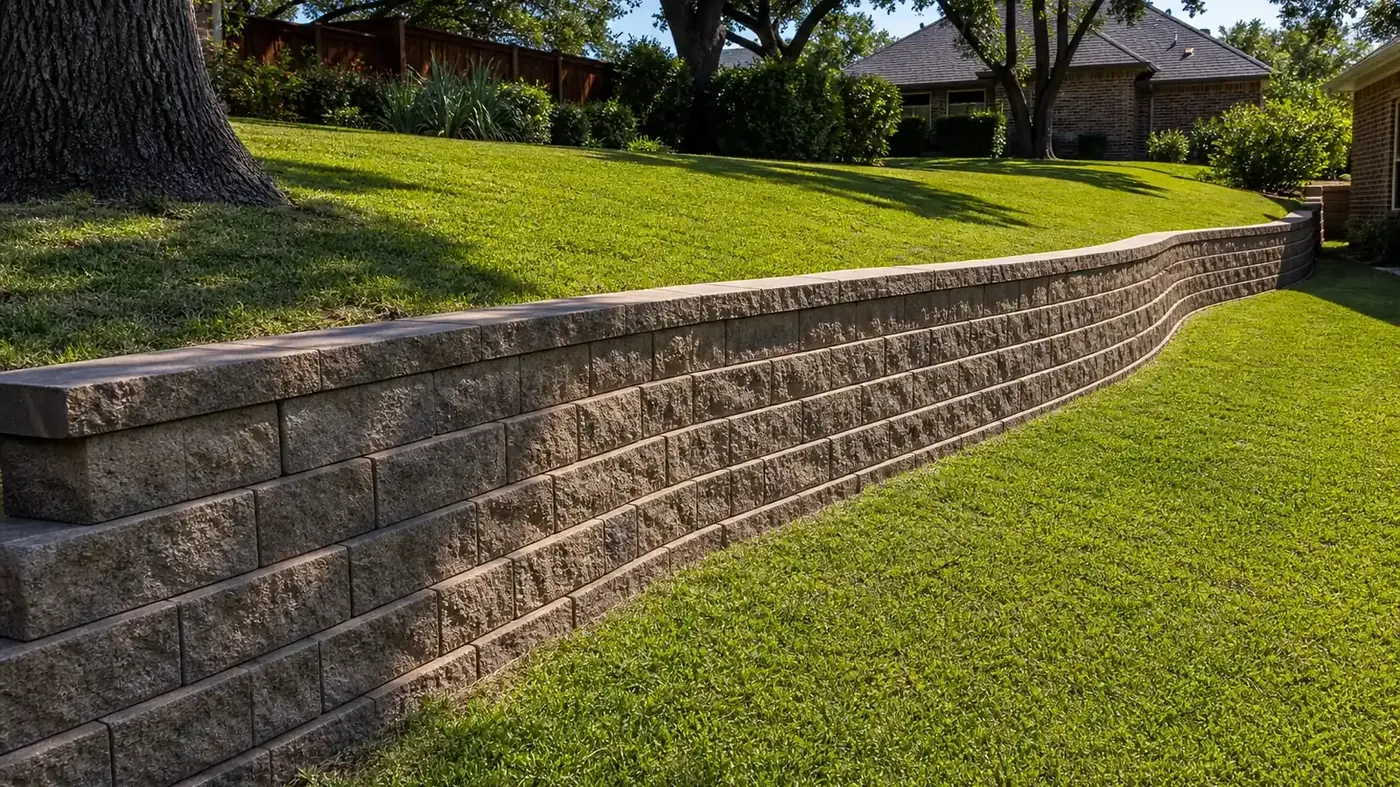
What Drives Retaining Wall Cost in North Texas
Retaining wall cost in North Texas comes down to five things. They are wall height, the drainage built behind it, the material on the face, site access, and whether the design needs an engineer. Height matters most, because the soil load behind a wall grows faster than the wall itself. Material is the factor homeowners see, but it is usually the smaller share of the price. The parts that keep a wall standing in clay soil are the parts nobody sees.
That is also why quotes for the same wall can come back thousands of dollars apart. The difference is rarely the stone. It is excavation depth, base thickness, gravel backfill, and drainage, the items a cheap quote quietly trims. This guide walks through each cost driver and what a complete quote should list. It also covers when a wall crosses into engineered territory, and the questions that separate a builder from a landscaper with a pallet of blocks. Keller, Colleyville, and Southlake homeowners comparing bids should read the quote section twice.
Ready to get started? Conroy's Lawn & Landscape provides professional lawn care and landscaping across Keller, Southlake, Grapevine, Colleyville, and the surrounding North Texas communities. Call 817.745.0424 or email service@conroyslawnandlandscape.com for a free quote today.
Why is height the biggest cost driver?
Height drives cost because soil load grows faster than wall size. A wall twice as tall holds back far more than twice the force, and everything behind the face has to scale with that force. The base course must be buried deeper and the backfill zone gets wider. Taller walls also need geogrid, a soil reinforcement mesh layered back into the slope as the wall goes up.
The practical breakpoints matter more than the exact numbers. A knee-high border wall around a bed is mostly a materials-and-labor job. A wall in the three to four foot range is a structural project with real excavation and drainage behind it. At roughly four feet and above, most Tarrant County cities require an engineered design and a permit. That adds design fees and inspection time before a single block is set. A sloped yard needing six feet of grade change is often better served by two tiered walls than one tall one. Tiering changes the cost picture again.
Does clay soil make walls more expensive here?
Yes, meaningfully. North Texas clay swells when wet and shrinks when dry, and it holds water against a wall long after rain stops. That means deeper embedment, more gravel, and non-negotiable drainage compared to what the same wall would need in sandy soil. Builders who work this soil price for it. Quotes that read like they were written for another region are the ones that fail here.
What does the money actually buy?
A retaining wall is mostly underground and behind itself. The visible face is the smallest part of the work. Here is where the cost actually sits, in rough order of importance.
| Cost component | What it is | What happens if it is skipped |
|---|---|---|
| Excavation and base | Trench cut into undisturbed soil, compacted aggregate base, first course buried | Wall settles unevenly and joints open |
| Drainage | Gravel backfill, landscape fabric, perforated pipe at the base run to daylight | Saturated clay pushes the wall over time; bulging and lean |
| Reinforcement | Geogrid layers tied into the slope on taller walls | Wall rotates forward under load |
| Wall material | Segmental block, natural stone, or veneered concrete | Cosmetic choice; affects price, not survival |
| Access and haul-off | Getting material in and spoil out, by machine or by hand | Not skippable; narrow access adds labor days |
| Engineering and permit | Design and city review on taller or load-bearing walls | Failed inspections, forced rebuilds, liability |
Material deserves its own note because it is the choice homeowners spend the most time on. Segmental concrete block is the workhorse: engineered for stacking, predictable, and the value option for structural walls. Natural stone costs more in both material and labor and earns it in looks. Many projects put block where the muscle is needed and stone where people see it. The stone work value guide covers how those choices play against resale.
What should a complete retaining wall quote include?
A complete quote names the invisible work. If two bids differ by thousands, the difference is almost always in this list. The way to compare bids is line by line against it.
- Excavation depth and base thickness, stated in inches, with the first course buried below grade.
- Backfill material, clean gravel behind the wall rather than the excavated clay shoveled back in.
- Drainage, fabric, gravel, and a perforated pipe at the base with a stated outlet point.
- Geogrid, specified by layer count on any wall approaching structural height.
- Material and cap, the block or stone by name, including the cap course and adhesive.
- Engineering and permit, who obtains them and whose stamp is on the design if height requires one.
- Haul-off and cleanup, where the spoil goes and what the yard looks like when the crew leaves.
A bid that just says wall, length, and price is not a cheaper version of the same project. It is a different project wearing the same name. Asking each bidder to confirm the seven items above in writing costs nothing and tells you immediately who plans to build what.
When does a wall need an engineer?
The common trigger across Tarrant County is around four feet of height, measured from the bottom of the base course rather than from grade. City rules vary, and some review at three feet. Anything supporting a surcharge, meaning a driveway, pool deck, or structure above the wall, can trigger engineering at any height. A builder quoting in Keller, Colleyville, or Southlake should know the local threshold without looking it up. The permit conversation belongs in the first site visit, not after the deposit.
Repairing a failed wall generally costs more than building it correctly the first time. Repair starts with demolition and haul-off before any new work begins. Most wall failures in this area trace to the same two omissions: no drainage behind the wall, and no buried base course. Both are invisible on day one and unmistakable within a few wet seasons. That is the honest answer to why the better quote costs more.
Ready to get started? Conroy's Lawn & Landscape provides professional lawn care and landscaping across Keller, Southlake, Grapevine, Colleyville, and the surrounding North Texas communities. Call 817.745.0424 or email service@conroyslawnandlandscape.com for a free quote today.
Retaining walls across Keller and Tarrant County
Our crews build walls across Keller, Colleyville, Southlake, Grapevine, Trophy Club, and Westlake, and the terrain drives what each city tends to need. Sloped lots in Southlake and Westlake produce the taller, engineered projects and the tiered designs. Colleyville and Keller work runs heavily to bed borders, seating walls, and the three-foot range that holds a grade without triggering review. Bedford, Watauga, and North Richland Hills lots are flatter on average, where walls are usually decorative borders and the cost conversation is shorter.
Every wall gets the same treatment regardless of size. Billy Conroy walks the site before the quote, and the quote lists the seven items above by name. Walls also rarely travel alone. Grading, drainage, and planting around a new wall are cheaper done in the same mobilization. That is why wall projects often pair with stone borders, retaining walls, and patios work or a broader landscape design and installation plan. Finished examples are in the stone work gallery.
Frequently asked questions about retaining wall cost
Why do retaining wall quotes vary so much?
Because the invisible parts of the wall vary. Two quotes for the same length of wall can differ on excavation depth, base thickness, gravel backfill, drainage pipe, and geogrid reinforcement. The cheaper quote usually leaves out part of what keeps a wall standing in clay soil.
Does a taller wall cost more per foot?
Yes, and the increase is not linear. Doubling wall height more than doubles the load behind it. That means a deeper embedded base course, more backfill, geogrid layers, and often an engineered design. A wall four feet or taller is a different class of project from a two foot border.
Do retaining walls in North Texas need drainage?
Yes, always. Clay soil holds water, and saturated clay pushes against a wall with far more force than dry soil. Gravel backfill, landscape fabric, and a perforated drain pipe at the base are what relieve that pressure. Walls quoted without drainage are the ones that bulge and fail.
When does a retaining wall need an engineer?
Commonly around the four foot mark, measured from the bottom of the base course. City rules across Tarrant County vary, and some trigger review at three feet or when a wall supports a driveway or structure. A builder should know the local threshold before quoting.
Ready to get started? Conroy's Lawn & Landscape provides professional lawn care and landscaping across Keller, Southlake, Grapevine, Colleyville, and the surrounding North Texas communities. Call 817.745.0424 or email service@conroyslawnandlandscape.com for a free quote today.