
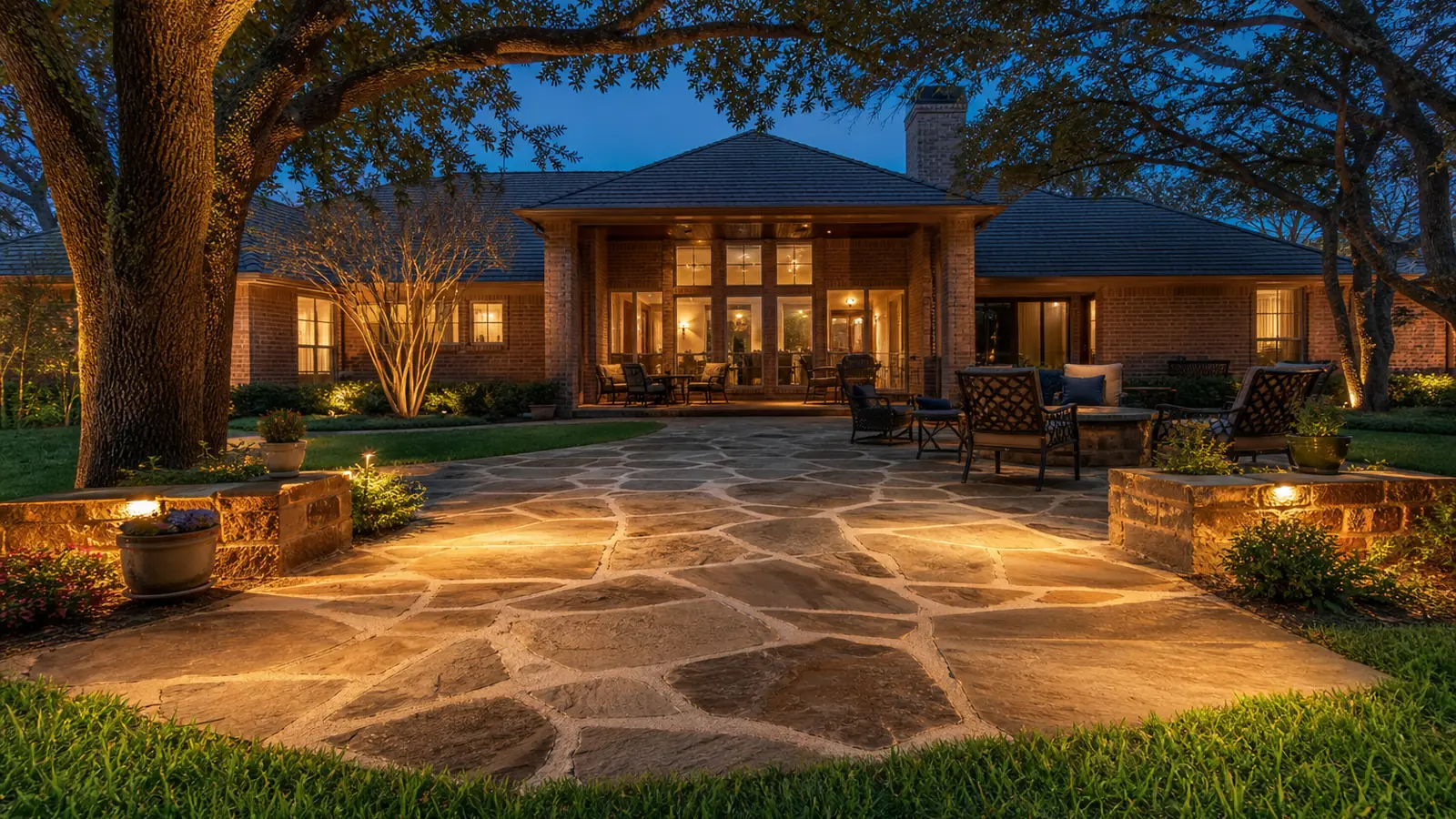
Flagstone vs Pavers: Choosing a Patio Material in North Texas
Flagstone gives a patio a natural, irregular, high-end look, while manufactured pavers give crisp geometry, faster installation, and usually a lower installed cost. Both perform well in North Texas clay when they are built on a properly compacted base. Both fail the same way on a bad one. The honest answer to which is better is that they are better at different things. The right choice depends on the look you want, the budget, and how the space will be used.
This comparison covers how each material looks and ages, and what drives the cost difference. It also covers how each handles clay soil movement and Texas heat, and what maintenance each asks of you over a decade. It also covers the mixed approach, which is often the smartest design across Keller, Colleyville, and Southlake yards. By the end the decision usually makes itself, because the two materials suit noticeably different properties and priorities.
Ready to get started? Conroy's Lawn & Landscape provides professional lawn care and landscaping across Keller, Southlake, Grapevine, Colleyville, and the surrounding North Texas communities. Call 817.745.0424, text 817.909.6875, or email service@conroyslawnandlandscape.com for a free quote today.
What is the real difference between flagstone and pavers?
Flagstone is quarried natural stone, split into irregular flat pieces, with every piece different in shape, thickness, and color. Pavers are manufactured concrete units, cast to uniform size and thickness in controlled colors and textures. That single difference, natural and irregular versus made and uniform, drives almost everything else: the look, the labor, the cost, and the repair story.
In North Texas the flagstone most people picture is Oklahoma flagstone. Its buff, brown, and rose tones sit naturally against brick homes and live oaks. Pavers have closed most of the beauty gap in the last decade. Modern lines include tumbled finishes, large-format slabs, and blended colors that read far less like concrete than the pavers of twenty years ago. The gap that remains is texture and randomness, which no mold fully reproduces.
How does each one age?
Flagstone ages like stone. It weathers, softens in color, and tends to look better at year ten than year one. Pavers hold their manufactured color for years, then fade gradually and evenly, and a sealed paver surface keeps its color longest. Neither ages badly. They age differently, and the difference matches the look each was chosen for in the first place.
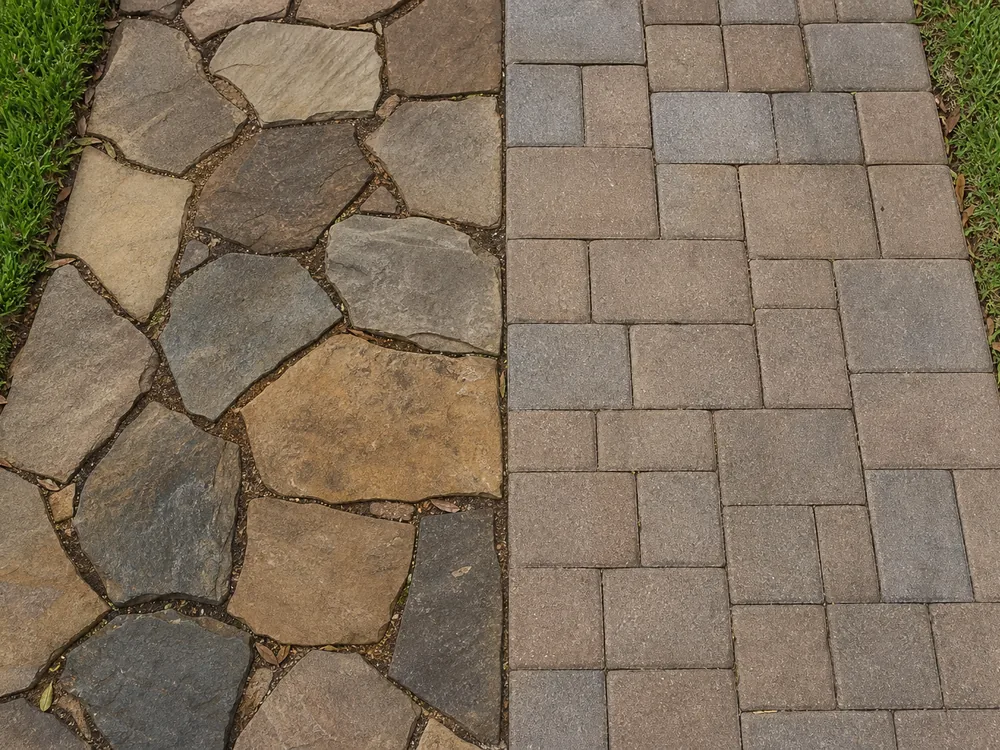
How do they compare side by side?
The table below puts the two materials against each other on the factors that decide real projects. The short version: pavers win on cost, speed, and repairability, while flagstone wins on natural character. The structural performance question is decided by the base rather than the surface.
| Factor | Flagstone | Pavers |
|---|---|---|
| Look | Natural, irregular, one of a kind | Crisp, geometric, consistent |
| Installed cost | Higher, driven by fitting labor | Lower for the same area |
| Installation speed | Slower, every piece is fitted | Faster, uniform units |
| Clay soil movement | Good dry-set, vulnerable in mortar | Good, flexes with the base |
| Repair | Harder to match and refit | Lift and relay invisibly |
| Heat underfoot | Dark stone runs hot in sun | Dark colors run hot in sun |
| Maintenance | Occasional joint refill, weed control | Joint sand top-up, optional sealing |
The repair row deserves emphasis in clay country. When a section of any patio settles, pavers can be pulled, the base corrected, and the same units relaid with no visible scar. Settled flagstone can be reset too, but matching and refitting irregular stone takes more skill and more time. Over a twenty year life on moving soil, that difference gets used.
Which one suits North Texas conditions?
Both, provided the build under them is right. Clay movement is the enemy of every hard surface in Tarrant County, and it does not care what the top layer looks like. The decisions that actually determine how a patio performs here happen below the surface, in this order.
- Excavation to stable soil, deep enough to get below the loose, organic top layer.
- A compacted aggregate base, thick for the load and compacted in lifts, not dumped in one pass.
- Drainage away from the surface, so water does not sit under the patio and feed clay movement.
- The setting method, dry-set on sand flexes with the soil; mortar-set is rigid and shows cracks when clay moves.
- Edge restraint, which keeps a dry-set surface from spreading at the borders over time.
The setting method is the one genuine North Texas caveat for flagstone. Mortared flagstone over a concrete slab looks permanent, and in stable soil it is. Over active clay, the slab and the mortar joints become the crack path. Dry-set flagstone on a compacted base sidesteps that, at the cost of slightly wider joints. A builder who works this soil will raise the question before you do, which is a useful test of who you are talking to. The guide on when to build a patio in North Texas covers how season affects that base work.
Ready to get started? Conroy's Lawn & Landscape provides professional lawn care and landscaping across Keller, Southlake, Grapevine, Colleyville, and the surrounding North Texas communities. Call 817.745.0424, text 817.909.6875, or email service@conroyslawnandlandscape.com for a free quote today.
What maintenance does each material ask for?
Neither surface is high maintenance, and the tasks differ more in kind than in effort. Pavers ask for joint sand topped up every few years and an optional sealer that deepens color and slows staining. Flagstone asks for joint material refilled as it washes, and weed control in the wider joints if the patio is dry-set. Both benefit from an occasional rinse and a check of the edges after a hard winter.
The maintenance question worth asking before choosing is about the joints. Tight paver joints filled with polymeric sand stay largely weed-free and firm underfoot. Wider flagstone joints can be filled with sand, decomposed granite, or even planted with a creeping groundcover. Each filling choice changes both the look and the upkeep. A patio is a ten to thirty year surface. An honest conversation about who will maintain it, and how much attention it will actually get, belongs in the design stage.
When does mixing both make the most sense?
Often. The mixed design uses each material where it earns its cost. Pavers go across the main surface, where square footage is large and durability matters most. Flagstone goes where eyes and feet linger: an entry walkway, a border course, a landing by the door, or a seating nook under a pergola. The budget goes further and the design reads as more custom, not less.
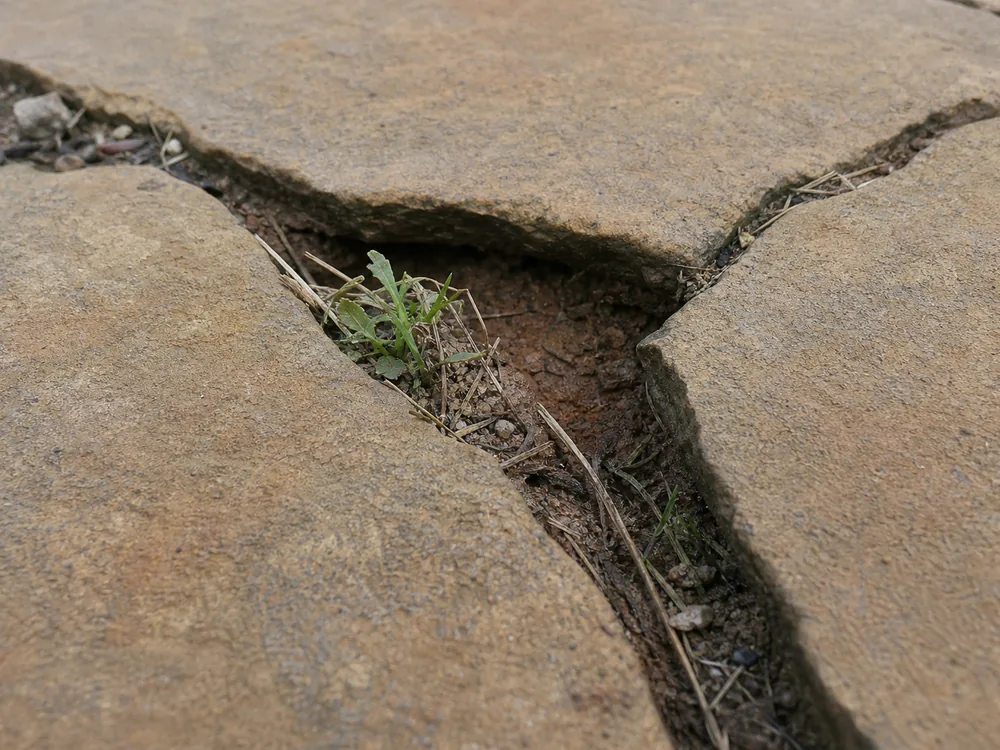
Mixing also solves the heat problem on pool decks. Light-colored pavers or light flagstone belong around the water where bare feet land. Darker accent material kept to borders and shaded areas keeps the surface usable through July. Color drives surface temperature more than material does, and that is a decision made at the sample stage, not after the install.
Patio materials across Keller and Tarrant County
Our crews build both across Keller, Colleyville, Southlake, and Grapevine, and the pattern in what people choose is consistent. Colleyville and Westlake projects lean flagstone and mixed designs, where the natural stone look fits larger lots and established trees. Keller, Bedford, and North Richland Hills projects lean paver-first, where budgets are tighter and the crisp look suits newer homes. Trophy Club and Watauga split down the middle.
Every project starts the same way regardless of material. Billy Conroy walks the site and looks at grade, drainage, and access. The material conversation happens with samples on the actual ground where the patio will sit. Stone that looks right on a screen can sit wrong against your brick. Finished examples of both materials are in the stone work and pavestones gallery. The broader options are covered under stone borders, retaining walls, and patios. Projects that pair a patio with beds and planting fall under landscape design and installation.
Frequently asked questions about flagstone and pavers
Which is cheaper, flagstone or pavers?
Pavers usually cost less installed. The units are uniform, so they lay faster with less cutting and less waste. Flagstone is quarried in irregular pieces that take longer to fit, and the labor of fitting is where the extra cost lives. Exact pricing depends on the stone, the size, and the site.
Does flagstone get too hot for bare feet in Texas?
Darker flagstone in full sun gets uncomfortably hot in a Texas summer, and so do dark pavers. Lighter colors in either material stay noticeably cooler underfoot. For pool surrounds and barefoot areas, color choice matters more than the flagstone versus paver question.
Which handles clay soil movement better?
Both handle movement well when built on a proper compacted base, and both fail on a bad one. Pavers have a small edge for repair, since a settled section can be lifted and relaid invisibly. Flagstone set in mortar is more vulnerable, because clay movement cracks rigid joints.
Can flagstone and pavers be combined in one design?
Yes, and it is often the best answer. A common approach uses pavers for the main surface where durability and budget matter. Flagstone then covers accent areas, borders, or a walkway where the natural look earns its cost. Good design puts each material where it works hardest.
Ready to get started? Conroy's Lawn & Landscape provides professional lawn care and landscaping across Keller, Southlake, Grapevine, Colleyville, and the surrounding North Texas communities. Call 817.745.0424, text 817.909.6875, or email service@conroyslawnandlandscape.com for a free quote today.